By Anouska Shenn
24th June 2026, 16:07 PM UTC
With a name like The Office Yoga Company, perhaps it’s not surprising that desk yoga has been a core part of our business since our founding nine years ago. We get questions from clients and teachers alike wondering what desk yoga is (yes, it is what it sounds like!) and how to start teaching it or offering it in offices and online. With that in mind, we put together this handy FAQ with the questions we hear the most often.
We’ve organised this into sections so you can quickly find what you’re looking for. If you have a question that isn’t answered here, send us an email and let us know.
Contents
- What is desk yoga?
- Does desk yoga actually work?
- What does the research say about desk yoga?
- Is desk yoga different from stretching?
- How is desk yoga different from chair yoga?
- Who is desk yoga suitable for?
- Do you need to be flexible to do desk yoga?
- Is desk yoga suitable for beginners?
- Is desk yoga suitable for all fitness levels and abilities?
- Why is desk yoga becoming more popular in workplaces?
- What are the benefits of desk yoga?
- Does desk yoga help with back pain?
- Can desk yoga help with neck and shoulder tension?
- Can desk yoga improve posture?
- Does desk yoga reduce stress?
- Does desk yoga help with focus and concentration?
- Can desk yoga increase productivity?
- Why should companies offer desk yoga?
- How long does it take to see benefits from desk yoga?
Bringing Desk Yoga into Your Workplace
- How do I introduce desk yoga to my workplace?
- What does a typical desk yoga programme look like?
- Should desk yoga be virtual or in person?
- How do remote teams participate in desk yoga?
- How often should employees do desk yoga?
- How long should a desk yoga session be?
- When is the best time to do desk yoga during the workday?
- How many people can join a desk yoga session?
Practical Considerations for Offering Desk Yoga at Work
- Can you do desk yoga in work clothes?
- Do we need mats or any equipment to do desk yoga?
- Can you do desk yoga in an open-plan office?
- How do I make desk yoga inclusive for employees with disabilities?
- What are the health and safety considerations for desk yoga?
- Can desk yoga be adapted for hybrid teams?
- How do I choose a desk yoga provider?
- What qualifications should a desk yoga instructor have?
- How do I get leadership buy-in for a desk yoga programme?
- How do I get employee buy-in for a desk yoga programme?
- How much does a corporate desk yoga programme cost?
- How do I measure the ROI of a desk yoga programme?
Understanding Desk Yoga
What is desk yoga?
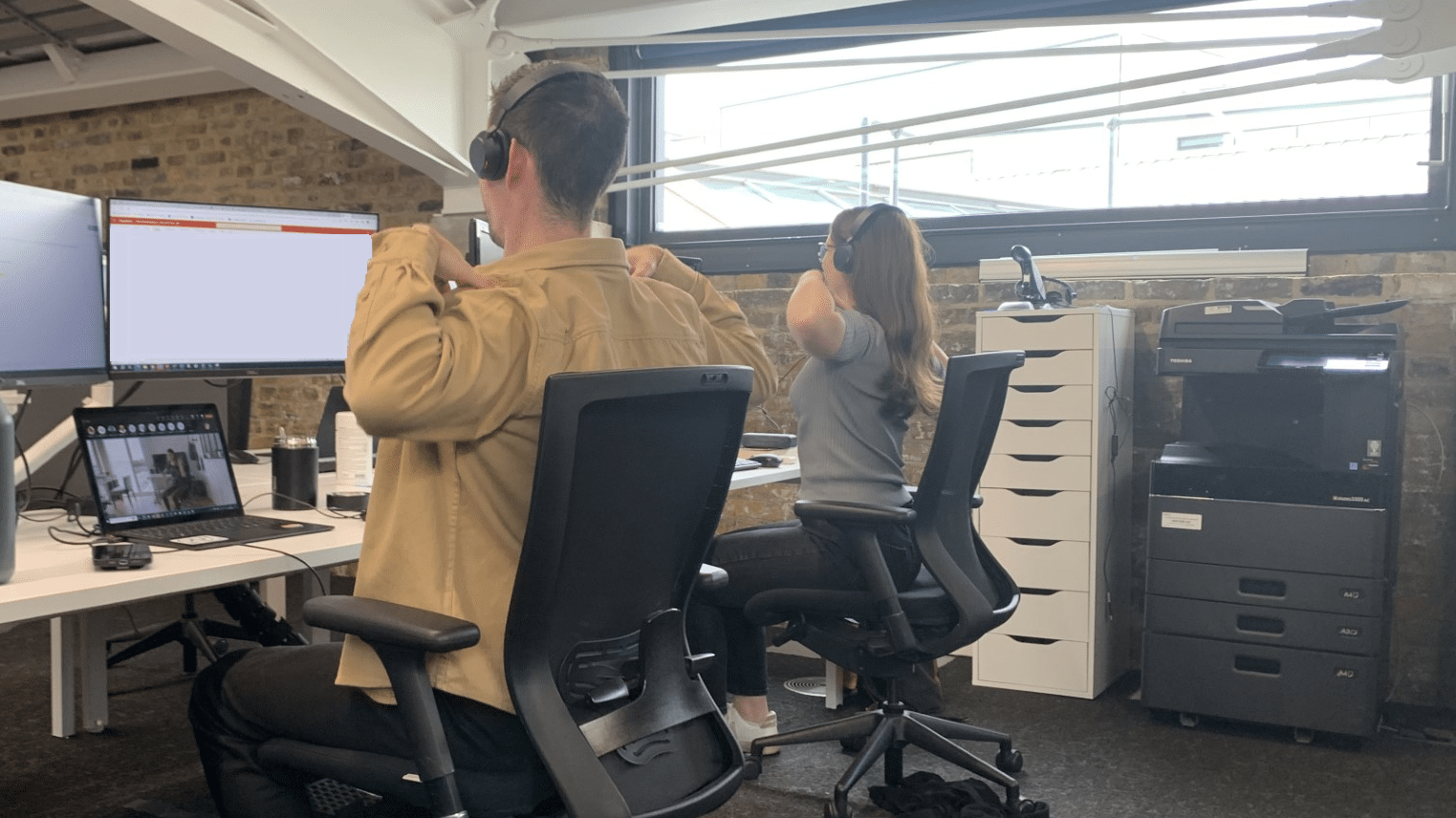
Desk yoga is mindful movement and stretching led by a qualified yoga instructor that can be practised easily at a desk. Some of the stretches may be adapted from mat yoga classes while others will be specific to desk yoga. Desk yoga classes are designed to slot easily into the work day and don’t get you sweaty. They can be practised in regular work clothes and all you need is somewhere to sit and, optionally, a bit of space to stand. Generally the poses are more compact and gentle in nature than those you might encounter in a mat-based class. Traditional props are used in mat yoga to support the body, assisting with proper alignment and balance. In desk yoga, the poses sometimes make use of the chair and desk as props. Classes may also include mindfulness and breathwork practices derived from yoga.
Does desk yoga actually work?
The short answer is yes. A regular desk yoga practice can help reduce muscle tension, improve posture, and ease the physical strain of prolonged sitting. Many participants also report feeling calmer and more focused after a session – benefits that are harder to measure but no less real.
Although research on chair- and desk-based yoga classes is limited, studies have shown that workplace yoga programmes can reduce stress, lower blood pressure, and improve overall wellbeing. Even short sessions of mindful movement during the work day can make a meaningful difference to how we feel, physically and mentally.
Desk yoga is not a substitute for regular exercise, but its value as a straightforward, accessible tool for managing the unwanted effects of desk work is hard to deny.
What does the research say about desk yoga?
The honest answer is that research specifically on desk yoga is still limited. Most existing studies look at yoga more broadly – mat-based classes, general workplace wellness programmes, or yoga practised outside of work.
Reviews of workplace yoga interventions have found consistent reductions in perceived stress, while studies involving office workers report improvements in lower back pain and overall wellbeing. While we can’t draw a straight line from these studies to desk yoga specifically, the underlying principles – mindful movement, breathwork, gentle stretching – are the same.
As desk yoga grows in popularity, so too will the body of research dedicated to it.
Is desk yoga different from stretching?
There is some overlap, but desk yoga is decidedly different from regular stretching. Stretching captures the physical aspect of yoga, targeting the muscles and connective tissue with the goal of increasing flexibility and relieving tension. Yoga goes further than this – it’s a mind-body practice that invites us to move with attention to the breath and sensations produced by each pose. It is a practice of mindfulness as much as it is of movement.
How is desk yoga different from chair yoga?
Practically speaking, desk yoga and chair yoga are the same. They are both a gentle form of yoga that is performed while seated, or using a chair for balance, to make the practice more accessible. Desk yoga is generally practised during the work day, at people’s places of work or while working from home. Classes may also make use of the desk as another stabilising surface in certain poses.
Who is desk yoga suitable for?
Desk yoga is suitable for almost everyone, regardless of their levels of fitness and experience with yoga. An important note to keep in mind – as with any physical activity, not all the exercises will be suitable for every individual. Those with injuries or certain medical conditions should follow the guidance of their doctors or physiotherapists before taking part.
If you are pregnant, we recommend avoiding desk yoga during the first trimester. From the second trimester onwards, you are welcome to join our desk yoga sessions provided you have attended prenatal yoga classes and know how to modify poses for your body. Please note that in a corporate class setting, we are unable to offer individual guidance on pregnancy modifications.
Do you need to be flexible to do desk yoga?
No, you don’t need to be flexible to do desk yoga, or to do yoga more generally. In fact, many people start practising yoga because they would like to become more flexible! Desk yoga is even less physically demanding than mat-based yoga, since the poses are adapted for smaller spaces and people wearing regular work clothes. For this reason, desk yoga can easily be practised even by people with limited range of motion. Like any yoga practice, desk yoga asks us to meet ourselves where we are – moving through each pose without straining, and with awareness and kindness.
Is desk yoga suitable for beginners?
Without a doubt! Desk yoga classes are designed with office workers in mind, many of whom may have never tried yoga before or have limited experience with it. The poses are accessible in regular work clothes – no Lycra needed – and modifications are offered to make each pose more or less challenging depending on your level. In our classes, we don’t use the Sanskrit names (such as Adho Mukha Svanasana). The poses are named in English, clearly explained step-by-step, and demonstrated by the instructor.
Is desk yoga suitable for all fitness levels and abilities?
Absolutely! Our desk yoga classes are designed to leave you feeling relaxed and free of tension, but never sweaty. The poses are more gentle and accessible than those in a mat-based class, making them suitable for all fitness levels and abilities. Classes can also be designed to be performed fully seated, with no standing postures, or with seated variations available for every pose – just let us know at the time of booking.
Why is desk yoga becoming more popular in workplaces?
Desk yoga is becoming increasingly popular in workplaces for a couple of reasons. The rise of remote and hybrid working has left many of us more sedentary than ever, spending long hours at a desk with fewer opportunities to move. Poorly set-up home workspaces have added to the problem, contributing to a rise in musculoskeletal complaints among remote workers.
At the same time, employers are investing more in staff wellbeing, recognising that a healthier, less stressed workforce is also a more productive one. Workplace sickness costs businesses over £103bn a year in the UK alone, according to a recent report by think-tank IPPR.
Desk yoga fits neatly into the working day without requiring a change of clothes, a trip to a studio or gym, or any prior yoga experience. It’s low-barrier, inclusive, and can be practised by almost anyone, making it an ideal wellbeing initiative for almost any team.
The Benefits of Desk Yoga
What are the benefits of desk yoga?
Desk yoga can bring a range of physical and mental benefits for those who spend long hours at a desk. It can help relieve muscle tension, reduce joint stiffness, and improve postural awareness – common complaints among office workers. It can also improve circulation and ease the discomfort associated with prolonged sitting.
Even a short session can help reduce stress and anxiety, improve concentration, and leave you feeling more focused and calm for the rest of the working day. For longer-term change, we recommend scheduling shorter 10-20 minute classes weekly or every other week.
If you have a particular aim for your class, whether that’s increased focus, relaxation, or team-building, let us know at the time of booking and we’ll tailor your session accordingly.
Does desk yoga help with back pain?
Desk yoga can be a valuable tool for managing lower back pain, but it works best as part of a broader approach. The causes of back pain are complex and multifactorial. An effective strategy takes into account a wide range of lifestyle factors including stress management, movement patterns, posture, sleep, diet, functional strength, and mobility.
Most of us will experience lower back pain at some point in our lives, and that number is rising. During the pandemic, an estimated 619 million people worldwide were living with lower back pain – a figure that is projected to increase further to 843 million by 2050. If you would like us to focus on yoga postures that are beneficial for relieving back pain, just let us know and we’ll make it happen.
Can desk yoga help with neck and shoulder tension?
Desk yoga can relieve neck and shoulder tension by gently releasing the muscles around the neck, shoulders, and upper back. In our classes, we focus on stretching muscles that get tight when we sit with poor posture and restoring functional movement to areas that get stiff or weak from inactivity. Neck and shoulder tension is one of the most common complaints among office workers, often caused by tech neck – the habit of jutting the head forward of the shoulders towards a computer or mobile screen.
For lasting results, short but regular sessions work best – to retrain the muscles and give tension less chance to build up in the first place. If your team only has budget for a single session, we recommend booking one of our desk yoga workshops, Yoga & Pilates at Your Desk, which includes a PDF handout summarising the main exercises for participants to keep.
Can desk yoga improve posture?
Desk yoga can indeed be beneficial for posture. You can think of desk yoga as a movement break in your day that mobilises the spine and relieves tension in muscles that are commonly tight when we sit for prolonged periods.
Poor posture is usually the result of muscular imbalance. Sitting for long hours tends to weaken the muscles of the core, glutes, and upper back, while tightening the hip flexors, chest, shoulders, and neck. Over time, this imbalance pulls the body out of alignment and into a more rounded, hunched position.
Desk yoga helps address this by stretching what is tight and activating what is underused. As with relieving neck and shoulder tension, we recommend regular practice for best results.
Does desk yoga reduce stress?
Absolutely! Stress relief is by far the most common reason clients book us to deliver yoga classes, whether desk- or mat-based. Yoga is not just a physical practice, but a mind-body one, that re-educates the nervous system to self-regulate. The breathwork and mindful movement that are central to every session encourage activity in the parasympathetic nervous system – the body’s natural relaxation response – helping to bring the mind and body into a state of calm. With regular practice, this embodied awareness grows. And while the stress response itself doesn’t disappear – and we wouldn’t want it to – you become more skilled at returning the nervous system to a state of calm.
Like other forms of exercise, yoga reduces levels of stress hormones and increases production of endorphins, our body’s natural painkillers. Yoga has also been shown to increase levels of brain chemical gamma-aminobutyric acid (GABA).
Low levels of GABA are associated with many common mental health conditions, including depression, post-traumatic stress disorder (PTSD) and attention-deficit/hyperactivity disorder (ADHD).
None of this requires a mat, a change of clothes, or a trip to a studio or gym. Some chairs and a quiet corner of the office are all you need.
Does desk yoga help with focus and concentration?
Desk yoga can help with focus by relaxing mental chatter and physical tension that get in the way of concentration. Many participants report returning to their desks after a session feeling calmer, more present, and better able to concentrate.
Consistent yoga practice has been shown to thicken the cerebral cortex – the area of the brain responsible for information processing – and hippocampus – the area of the brain involved in learning and memory – compared with non-practitioners. These are areas of the brain that are known to shrink as we age, which suggests that doing yoga regularly can help to counteract age-related declines in memory and cognition. Scientific research also shows that yoga and meditation may improve reasoning and problem-solving abilities.
As mentioned in the previous section, yoga has been shown to increase production of neurotransmitter gamma-aminobutyric acid (GABA). Low GABA can cause difficulty concentrating and memory problems. One of the ways GABA works is by slowing down messages being sent by other neurotransmitters, which allows the brain to process more information without tipping into anxiety or overwhelm.
Can desk yoga increase productivity?
This is a difficult claim to make directly because productivity is influenced by so many factors. What we can say with confidence is that desk yoga addresses several key barriers to productivity: stress, physical discomfort, and low mood.
A workforce that is less stressed, less impacted by aches and pains, and more adept at regulating their nervous system is, by extension, a more productive one. In that sense, desk yoga doesn’t increase productivity directly but may remove barriers that get in the way.
Why should companies offer desk yoga?
Employee wellbeing is now widely recognised as an important pillar of employee experience and company culture. Gallup’s State of the Global Workplace 2024 report found that employees who strongly agree their employer cares about their overall wellbeing are 69% less likely to actively search for a new job. The question is no longer whether or not to invest in employee wellbeing, but one of where those investments can have the most impact.
There is also a strong business case, for those keeping an eye on the numbers. Numerous studies have shown that workplace wellbeing programmes can improve staff retention and productivity, help attract and retain talent, and reduce the number of days lost to stress-related illness. Deloitte’s recent Mental Health and Employers report estimated an average return of £5.30 for every £1 invested in employee mental health initiatives.
Desk yoga is an inclusive activity that can support employees both physically and mentally. It encourages people to move more during the work day to help manage and prevent desk-related aches and pains, and provides an opportunity to mindfully pause and reset, while also engaging with their colleagues in a relaxed, collaborative way.
Unlike many wellbeing initiatives, desk yoga requires no special equipment, can be delivered in a relatively small space or remotely, and is accessible to people regardless of their ages and fitness levels. This makes it a practical option for companies looking to support their colleagues in a way that is both evidence-based and easy to implement.
How long does it take to see benefits from desk yoga?
Some of the benefits described in the sections above can be enjoyed from your very first desk yoga session. Like all mindfulness and movement modalities, the benefits compound with regular practice. Most practitioners start to notice improvements after two or three months. We recommend practising yoga at least once a week for best results.
A randomised controlled trial with NHS employees found that yoga may reduce disability associated with back pain and sickness absence due to musculoskeletal conditions after an eight-week programme.
Bringing Desk Yoga into Your Workplace
How do I introduce desk yoga to my workplace?
The easiest way to introduce desk yoga is to start small. Rather than launching a large-scale wellbeing programme, consider offering a one-off session during a company event, awareness week, lunch-and-learn, or team meeting. This gives employees an opportunity to experience desk yoga first-hand and helps you gauge interest before committing to a longer-term programme.
When promoting the session, it’s worth emphasising that desk yoga is designed specifically for beginners. Participants do not need any previous yoga experience, gym clothing, or equipment, and all the exercises can easily be performed while seated at a desk.
If the response from the group is positive, you can build on this momentum by introducing regular or semi-regular sessions. In our experience, short virtual classes delivered weekly, fortnightly, or monthly tend to achieve the highest levels of participation and engagement.
If you’re unsure where to start, we’re always happy to advise on the format, frequency, and delivery method that best suits your organisation.
What does a typical desk yoga programme look like?
We’ve been offering desk yoga classes for over nine years to 15,000+ employees in 71 countries around the world. While any amount of movement is beneficial, we’ve found that shorter, more frequent sessions tend to have the greatest impact and highest levels of participation.
We work with several businesses on an ongoing basis who book either weekly, fortnightly, or monthly desk yoga classes typically lasting 15-20 minutes. We also work with many businesses on a more ad hoc basis, who book our classes for awareness days and weeks (for example, Mental Health Awareness Week) and other workplace events.
For organisations planning a one-off session, our desk yoga workshop Yoga & Pilates at Your Desk includes handouts summarising the poses and practices covered, so your employees can continue using the techniques after the session.
Should desk yoga be virtual or in person?
Desk yoga can be offered virtually, in person, or a hybrid of the two. The best option is just the one that works best for your team, or workforce.
If team-building is the goal, in-person sessions are the obvious choice. There’s something about breathing and stretching together in the same room that creates a sense of shared experience that a virtual session can’t quite replicate. That said, virtual sessions have their own advantages: no travel, no room booking, and the ability to include colleagues who are based in different locations or working remotely. They are also more inclusive, removing barriers for employees who might otherwise find it difficult to attend in person – whether due to medical conditions, mobility issues, or caring responsibilities. Hybrid sessions can offer the best of both worlds when in doubt.
How do remote teams participate in desk yoga?
We deliver virtual sessions for companies with hybrid working patterns, multiple offices nationwide or globally, distributed teams, and employees who spend much of their day off-site – for example, salespeople and engineers. There are two ways to include your remote-working teams. We run fully virtual desk yoga sessions privately for corporate teams on Microsoft Teams. These sessions can also be recorded for your staff across different time zones to enjoy. We can also offer hybrid facilitation for sessions hosted at your office. Your instructor will bring the recording equipment and we will provide the event registration link for your remote participants.
How often should employees do desk yoga?
While a desk yoga session every once in a while is still a lovely way to treat your colleagues to a mindful pause and reset in their week, for longer-lasting effects we suggest running classes at least every other week, but ideally weekly. If your budget only stretches to a single session, we offer two options to extend the benefits beyond the live class itself: a desk yoga workshop with a PDF handout summarising the exercises, or a recording of the session that participants can revisit afterwards. Recordings can be made available for a period ranging from one week to one year, depending on your requirements.
How long should a desk yoga session be?
It depends on how frequently the sessions are offered. 15-20 minutes is plenty if run once a week or more. 20-30 minutes is ideal for fortnightly or monthly sessions. For quarterly or less often, we suggest anywhere from 30-60 minutes, depending on how much time your team has.
When is the best time to do desk yoga during the workday?
The best time to offer desk yoga is whenever your employees are free, because the best desk yoga class is one that people can actually attend. It might be helpful to ask your team or check people’s calendars before you book if you’re unsure. That said, many of our clients find that a mid-morning or lunchtime slot works well – far enough into the day for people to have settled into their work, but with enough of the day left to enjoy the benefits.
How many people can join a desk yoga session?
For in-person desk yoga, sessions can be delivered for teams of any size, including at large-scale events. We generally recommend capping attendance at around 20-25 people per session. At this size, the session still feels interactive, and the instructor can meaningfully connect with everyone taking part.
For online sessions, unless the group is very small and familiar, attendees will tend to have their cameras off. We use Microsoft Teams, which can host up to 11,000 participants – after 1,000 attendees, additional participants join in view-only mode.
Practical Considerations for Offering Desk Yoga at Work
Can you do desk yoga in work clothes?
Yes, desk yoga can be done in regular work clothes – no Lycra needed! Looser-fitting clothes or clothes with some stretch are preferable, but not essential.
Do we need mats or any equipment to do desk yoga?
Not at all – one of the defining features of desk yoga is that it requires no equipment whatsoever. All you need is a chair and enough space to stand and move in.
Can you do desk yoga in an open-plan office?
Yes, if your office is open-plan, you can have your team take part right at their desks – whether the class is offered in person or remotely. This works well when most or all are taking part, so there’s no awkwardness about being one of only a few stretching.
That said, a conference room or any space where chairs can be laid out works just as well – no desks or tables required. Some teams prefer having a room or space booked out so they don’t disturb their colleagues.
How do I make desk yoga inclusive for employees with disabilities?
The good news is that desk yoga is already an inclusive movement practice thanks to its emphasis on seated postures and working within a comfortable range of motion.
To make desk yoga even more inclusive for employees with disabilities, let your provider or instructor know in advance. A good instructor will ensure that every pose has a seated option, or can design the class to be fully seated with no standing poses at all. The more information they have about your team, the better they can tailor the session.
As noted above, virtual classes are also more inclusive, removing barriers for employees who might otherwise find it difficult to attend in person – whether due to medical conditions or mobility issues. Virtual sessions can also be closed captioned in real time by the conferencing app, allowing those with hearing impairments to take part.
What are the health and safety considerations for desk yoga?
Desk yoga is a low-risk activity, but as with any physical activity, there are a few health and safety considerations to keep in mind.
Participants should be encouraged to work within their own comfortable range of motion and to let the instructor know if anything causes discomfort. Desk yoga should never be painful – if it is, the participant should stop and rest.
Participants should also be invited to let the instructor know privately if they have injuries, medical conditions, have recently had surgery, or are pregnant. They may be required to complete a liability waiver form before attending a session. Some of our more risk-averse clients also produce a waiver form of their own for employees to complete.
From a practical standpoint, make sure the space is clear of trip hazards and that chairs are stable and positioned safely. For standing poses, participants should have enough space around them to extend their arms without the risk of knocking into a colleague or any furniture.
Finally, ensure that your provider holds the appropriate insurance for delivering exercise classes in a workplace setting. Any professional corporate yoga provider should carry public liability insurance as standard – if in doubt, ask for confirmation of this ahead of booking.
Can desk yoga be adapted for hybrid teams?
We deliver hybrid sessions for companies with flexible working patterns, multiple offices nationwide or globally, distributed teams, and employees who spend much of their time off-site – for example, salespeople and engineers. There are two ways to include your hybrid teams. We run fully virtual desk yoga sessions privately for corporate teams on Microsoft Teams. These sessions can also be recorded for your staff to enjoy on demand. We can also offer hybrid facilitation for sessions hosted at your office. Your instructor will bring the recording equipment and we will provide the event registration link for your remote joiners.
Choosing a Desk Yoga Provider
How do I choose a desk yoga provider?
Once you’ve covered off the basics – namely, qualifications, insurance, where they are based, and relevant experience – you can dig deeper into the company’s credentials. How long have they been in business? Is desk yoga their specialty, or one of many services they offer? Are they an independent teacher, a boutique agency, or a large one – and does that matter for what you need? Do they have reviews or case studies you can browse on their website, or on Trustpilot? Has the company won any awards or been recognised in the press? How do they describe their teaching approach and what makes them different?
Once you’ve made a shortlist of a few potential providers, email each one with your brief and ask for a quote. You should include the quantity of classes you are looking to book, your timeline, your budget (if known), your aims for the session(s), who the class is for and why, how many people you anticipate joining, and where the class will take place. We recommend emailing no more than five providers rather than a scattergun approach, and providing enough information in your initial email to get things rolling. Depending on how large the potential contract is, you may also want to speak with the providers you’ve shortlisted to get a more tailored proposal.
Once you’ve heard back from your shortlist, it’s time to compare again. Now you should have a clearer idea about each provider’s booking process, what they offer, and the cost. If budget is a concern, you may just be looking for the cheapest option – in which case, your decision will be very straightforward. Keep in mind that your largest cost will be the collective time your employees are spending away from their desks. When comparing quotes, the lowest-cost provider may catch your eye, but price differences often represent a relatively small amount compared to the total resource being dedicated to these sessions. For example, when bringing together 50 employees for an hour-long session, the difference between provider quotes might be £50-500 – a trivial amount compared to the overall investment in employee time and potential impact of the session.
Focus on selecting providers based on their expertise, track record, and ability to deliver relevant, high-quality sessions rather than choosing solely on price. A well-delivered desk yoga programme will have a positive knock-on effect on your employees’ wellbeing and engagement that far outweighs its cost.
What qualifications should a desk yoga instructor have?
At minimum, your yoga instructor should have completed a foundational yoga teacher training with an accredited yoga school. This will usually be a 200-hour certification or equivalent. They should also hold valid public liability insurance and an up-to-date first aid qualification. Some instructors may have completed additional training in areas such as chair yoga or corporate yoga, though this is not essential. Experience teaching yoga in office settings is valuable and often a requirement for teaching at a corporate yoga agency.
How do I get leadership buy-in for a desk yoga programme?
The most effective approach is usually to link desk yoga to outcomes that your leadership team already prioritises. While improving employee wellbeing or social connection may be your primary goal, desk yoga can also support employee engagement, retention, help employees manage desk-related aches and pains, and even improve productivity, as noted above. These aren’t trivial concerns: Gallup’s 2024 State Of The Global Workplace report estimates that only 20% of employees worldwide are engaged at work, and asserts that this may result in “decreased productivity, higher turnover rates, and lower overall company performance”.
If you’re proposing a recurring programme, it can be helpful to start with a pilot session or short trial period. This allows employees to experience the benefits first-hand and provides an opportunity to gather feedback before making a longer commitment. We recommend booking a series of four to six sessions if budget allows, to give the pilot enough time for word to spread around the business.
How do I get employee buy-in for a desk yoga programme?
The biggest challenge is often overcoming misconceptions people have about yoga. Many employees assume they need to be flexible, physically fit, or already interested in yoga to take part. In reality, desk yoga is designed to be accessible for people of all ages and experience levels, and require no change of clothes or any equipment.
When promoting the programme, focus on the outcomes rather than the activity itself. Employees are often more interested in reducing stiffness, relieving tension, improving focus, or taking a short pause in their day than they are in practising yoga for yoga’s sake.
Keeping sessions short can also help encourage participation. In our experience, 20-minute classes are easier for employees to fit into their day and can feel less intimidating than a traditional 60-minute yoga class.
Finally, encourage your leadership team to actively endorse the initiative and take part in the sessions if their schedules allow. Visible support from leaders can have a positive impact on participation and engagement.
How much does a corporate desk yoga programme cost?
The cost of a corporate desk yoga programme will depend on factors such as the length of the commitment, the frequency of the sessions, whether the classes are delivered in person or online, the size of the group, and the location of your office.
In general, virtual sessions are the most cost-effective option since they can be delivered to employees across multiple offices and remote workers simultaneously. Organisations looking to maximise impact on a limited budget often choose shorter, recurring sessions delivered online. If weekly sessions aren’t possible within your budget, you could also consider running the sessions less frequently and offering recordings for people to watch on demand in the weeks in between. We even have some clients who book a single session once a year and provide the recording year-round for their staff to refer back to.
We offer both one-off sessions and ongoing programmes, and we’re happy to provide a tailored quote based on your requirements.
How do I measure the ROI of a desk yoga programme?
Measuring the ROI of a desk yoga programme can be challenging because many of the benefits, such as improved wellbeing, reduced stress, and stronger social connection, are difficult to quantify and attribute directly. Desk yoga is typically one component of a broader wellbeing strategy rather than a standalone intervention.
That said, there are several ways to evaluate its impact. Participation rates and, in particular, repeat attendance can be a useful indicator of employee engagement, while surveys can help measure self-reported changes in areas such as stress, energy levels, focus, and overall satisfaction with the programme.
We find the best way to capture the impact of a desk yoga programme is through stories rather than hard numbers. Whether formally or informally, you can invite the participants to share their experiences of the classes – what they find valuable and what keeps them coming back.
Ultimately, the most helpful measure of success is whether employees find the sessions relevant and continue to return.
Ready to start?
If you’re considering desk yoga for your workplace, get in touch to discuss the format that would work best for your team.
Anouska Shenn writes about workplace wellbeing from London, where she develops and delivers virtual and in-person programmes that have reached over 15,000 office workers across 71 countries. Her insights have been featured in more than 25 major publications including Forbes, Newsweek, and GQ.